GOOFTAGU

DIGITAL INNOVATION, INCLUSION & INTEGRATION


Leave a comment

Building Trust as Foundation for Inclusion: Financial Literacy Programs (Part 2)

– continued from Part 1 –

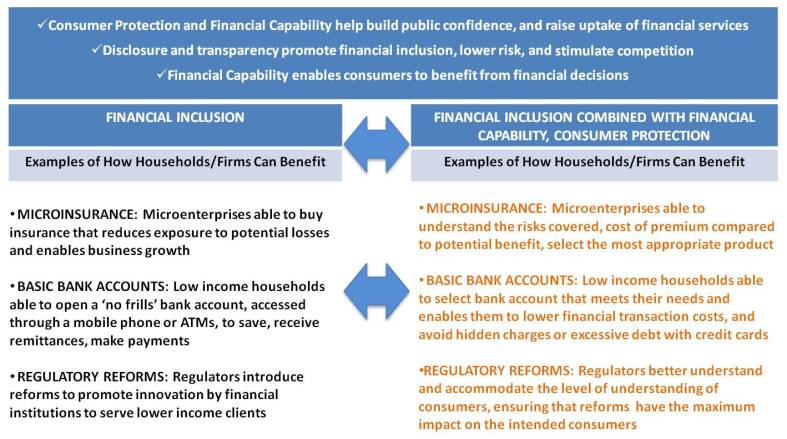
Financial Inclusion of Poor Source: The World Bank

Financial literacy means different things to different people. Financial literacy is a prerequisite for maximizing welfare, both individually and for society generally. In the developing world, the correlation between income and access to financial services remains very strong. But it is also a “chicken and egg” question. Does higher income bring better access? Or does increased access lead to higher incomes?  Thus intervening on the side of greater access (given the access to Digital channels / mobile devices) help provide impetus for job creation and more income opportunities.

But, importantly, we have found that greater access alone can easily lead to a personal financial crisis if people do not clearly understand how the system works—and what new products really offer. Everyone given the opportunity to avail of these services needs to be financially literate. And this is true whether one is poor, lower or middle-income, or high net worth individuals. For the poor, the vulnerability is particularly acute. Cash management at the best of times is difficult. Even without access to the system, financial literacy encompasses knowing how to manage income volatility and facing unexpected emergencies without falling into a debt trap—often from unscrupulous usury informal finance.

So, carefully explaining the benefits of joining the formal financial system is a critical—if difficult—first step. As one rises the income ladder, literacy means understanding increasingly complex financial products, what they can offer, and the potential risks and pitfalls. It affects individuals and households. But it also has an impact on overall financial and economic stability. At all levels, understanding even rudimentary finance is essential for daily life. Unfortunately, most do not.

Technological advances have led to greater efficiency and made products more user-friendly. Use of mobile phones and ATM systems for receiving income and paying bills is making rural areas far less remote. Cash transfer systems increasingly employ them. Computer and internet banking are becoming ever more common. On the downside—so are threats from unscrupulous agents. Information asymmetries and irrational emotions lead to bad financial decisions. That is why it is so crucial people know what new gadgets can and cannot do. It is why awareness of phishing, or other scams is important. And critically, it is why regulators must ensure financial education accompanies financial access and inclusion. Financially literate consumers can assess risks and make informed decisions about the suitability of financial products to their specific situation. Thus, information disclosure must go hand-in-hand with boosting financial literacy to ensure a level playing field.

As governments face debt and cost limitations, individual responsibility for financial planning takes on greater importance. And it is happening precisely when individuals are seeking better job security—in an environment where financial institutions are wary of providing excessive credit. Unexpected shocks can be devastating. And this is where, for example,micro-insurance holds so much potential. Financial literacy programs must incorporate better risk management of credit,savings, and insurance. They need to balance basic math—like calculating interest and real returns, for example— with basic financial concepts and how financial entities like pensions, mutual funds, and insurance works. Most importantly, financial literacy programs need to ensure participants know how to find out more when they need to. Financial education must start early and continue through adulthood.

Greater financial access combined with financial education creates financially responsible citizens. This mix of financial access and financial education provides a foundation for appropriate market conduct and prudential regulation. A standardized financial education curriculum could be developed in line with the interests and needs of children, teenagers, and young adults (poor people). But teachers need to be financially literate first. Improving individuals’ financial behavior has become a long-term policy priority in many countries. And it has notably led to the development of a wide range of financial education initiatives by governments, regulators and various other private and civil stakeholders, often combined with financial consumer protection measures.

That is why financial literacy and financial inclusion have become such prominent global issues. Following the global financial crisis, inclusion moved quickly onto the G20 agenda.

The September 2009 Leaders’ Summit in Pittsburgh pledged “to support the safe and sound spread of new modes of financial service delivery capable of reaching the poor.” It also called on financial standard setters to “promote successful regulatory and policy approaches and elaborate standards on financial access.” This was designed to make international financial standards relevant to emerging markets, particularly in building the regulatory environment for products such as micro-insurance, and to involve the private sector in the process.

  • By the 2010 Summit in Seoul, the G20 had developed a “Financial Inclusion Action Plan” and committed to launch the Global Partnership for Financial Inclusion, or GPFI.
  • At the June 2012 G20 Summit in Los Cabos, Leaders endorsed a set of “High Level Principles on National Strategies for Financial Education”—produced by the OECD/ International Network on Financial Education.
  • And in March 2014, the new GPFI Sub-group on Financial Literacy and Financial Consumer Protection was created. This has provided global momentum.

Although ASEAN governments have progressively promoted financial literacy, many challenges remain. These include

  1. Large rural or remote areas with difficult physical access,
  2. The need for better supervisory capacity among financial regulators,
  3. Legal frameworks for financial consumer protection and financial literacy, and
  4. Addressing the pervasive “informal” markets that handle lending, insurance, and remittances for those unable to tap into the formal system.

As the arteries of finance spread, we will see more mobile and branchless banking; electronic retail payment systems; streamlined remittance structures; deeper financial infrastructure in creating financial identities, data flows, and building legal frameworks for secured lending.

However, for these to work in expanding access and promoting job creation, financial literacy and consumer protection are fundamental prerequisites. Together they must be able to instill trust in financial products and the financial institutions that offer them. Trust is the foundation underlying financial products and services.

They cannot work otherwise.  So how can we ensure this will happen?


Leave a comment

The three “I’s” – Innovation, Inclusion, and Integration are central to Financial Literacy Programs (Part 1)

Some of the relevant insights as shared by Mr. Stephen Groff, ADB VP at the ASEAN Financial Literacy Conference, held in Brunei Island, during late 2013.

Development stems from innovations and new technologies that significantly reduce costs and increase efficiency in offering financial services to the poor, the traditionally unbanked, and to micro, small, and medium-sized businesses. For small and medium-sized enterprises—which are truly the future backbone for ASEAN development and growth (and rebalancing toward domestic demand)—financial literacy can activate financial opportunities for investment. The development of mobile and branchless banking, improvements in credit information systems, risk analytics, and electronic data security have allowed these groups greater access to finance. Much of its success, however, pivots on the quest for financial literacy.

Innovation is in Asia’s blood—even paper money was invented in Asia. Innovation is at the forefront of the drive toward financial literacy. Services must be offered outside traditional channels to reach a wider customer base. And, in many cases, it is non-bank innovation that has led the way in bringing the message across to traditional financial vendors.

Over the past decade, from internet commerce to remittance transfers, financial institutions have played catch-up in accommodating ways of servicing the unbanked. Policy makers face the challenge of how to regulate and guide this evolution. As we know, those who want to subvert the system through greed are usually first-line innovators. So regulators must be savvy enough to stay one step ahead.

Here’s an example of two mobile phone financial services introduced in the Philippines—the bank-based so-called Smart Money, and the non-bank based G-Cash system. The two services received initial authorization to launch from the Central Bank even though there was little regulation in place. Instead, the Bangko Sentral chose to allow a carefully controlled pilot phase to test different business models, and used the results to innovate relevant and effective e-money regulations. These now address the risks arising from new mobile channels and allow a variety of models to flourish, while maintaining the safety and soundness of the system. It has not been all smooth sailing. The Central Bank maintains an open dialogue with industry and civil society to foster an environment conducive to innovation.

Part of that is creating the right risk protection instruments for those new to financial access. Unaffordable and inadequate insurance products, informal insurance schemes, and low appreciation of micro-insurance are some of those hurdles ASEAN countries face.

The Philippine Government, together with the ADB-administered Japan Fund for Poverty Reduction and German International Cooperation, for example, have been working to enhance financial literacy on micro-insurance, especially for the poor.

Inclusion has grown to become the development sound bite of this era. Its formal definition is having “universal access, at reasonable cost, to a wide range of financial services, provided by a diversity of sound and sustainable institutions.” The nine G20 Principles for Innovative Financial Inclusion together form a set of conditions conducive to drawing in those currently isolated from financial systems, while safeguarding financial stability and  protecting consumers.

Estimates vary by country, but it appears some 70%–80% of adults in the region remain outside the formal financial system. Encouraging banks to service rural and far-flung regions, continuing efforts to promote and expand micro-finance, building outreach programs, working through local governments and community organizations are all ways to communicate the value-added of financial inclusion. And with available technology, it can be demonstrated on the spot.

But it must be promoted along with an equitable and transparent consumer protection infrastructure—a vital part of any broad financial inclusion framework. For governments, this means that promoting financial literacy is an integral part of inclusion. Best practice indicates that effective initiatives focus on providing practical, easy-to-understand and impartial advice so that consumers can make informed choices. From the regulatory side, “proportionate regulation” is becoming popular—whereby market development is encouraged by tailoring the regulatory burden to the risk characteristics of business, and creates incentives for future financial inclusion.

As innovation allows for more inclusion and better integration, clearly our experience in acknowledging financial literacy as a fundamental prerequisite for successful micro-finance or micro-insurance projects means our own approach is constantly evolving.

“Deliver comprehensive support through financial inclusion, literacy, and education”.

Consumer protection is essential if we are to build trust in the systems we help build. And that is why financial literacy is so important. Financial literacy and financial inclusion comes in stages, starting with initial contact, the introduction of mobile transfer and payment schemes, then savings and borrowing, followed by more complex aspects such as investing or insurance. The region’s poor need more than loans— there needs to be the financial literacy for people to choose wisely. As It revolves around trust—whether in the regulatory structure or the system itself. Innovation, inclusion, and integration flow through ASEAN’s arteries.

All three “I’s” are central to building financial literacy across the region, particularly for those still relying on informal finance.


Leave a comment

As smartphone gets cheaper than a bicycle, its jingle bells for digital cash and mobile money

1 picIt actually started to bite me in early 2007, when the thought of exploring the unknown… outside traditional technology and working for a while beyond the cubicles of corporate, came to my mind. Since last year, my friends have been nudging me to share my exotic experiences, as quite a few of them had made subtle indications, of-course post few rounds of beer, to retire for the better good of the investors. Often after midnight, I would say early mornings, I landed up paying for the endless beer and wine bottles. I have now become wiser, and it makes a good reason to share all those stories publicly, as my wallet feels safer and my friends can sit at their own cosy home, get their own beer cans and wine bottles and read Gooftagu on their tablets. I would talk another time about why I created Gooftagu..

During my school days, I went to spend my summer holidays, with my parents at a hill station in central India, where my dad was a medical doctor at the only general hospital in a district inhabited by three million people. He had three hundred beds and three other doctors supporting him to take care of the local inhabitants. Everyday morning, I saw the locals riding their bicycles coming down from their villages for selling their farm grown vegetables, eggs, milk, fish, including live chicken, rabbits, parrots, and lots of their own cottage stuff. They would mostly pay for their medical expenses with cash they got from selling their goods, and there were few who would try to exchange or barter their eggplants or other items for medicines and their treatments. Dad wasn’t happy about that, and he would take that personally and quietly pay on their behalf from my mom’s household expenses, and mom wasn’t happy either.

For these village folks, the most precious thing was their bicycle that they would not exchange for any reasons. Their lives would end in the absence of that human powered, pedal driven, single track vehicle. Before sunset, they would always cycle back to their villages with their cash and medicines. After so many years, probably their lives have changed, all of them now having mobile phones and are a part of the better world. Hopefully, their children and grandchildren have got education and now having secured meaningful earnings from their work areas. Given a choice today, between a bicycle or a smartphone, they would first pick a smartphone and probably claim both on a second chance. One thing, I am still unaware, whether they have any bank accounts today, since in those days it was only meant for the educated lot.

I opened my bank account at the official age of eighteen, and when I went to college. I queued up at the bank’s branch office during lunch hours to withdraw cash and have my bank’s pass book updated. Thirty-two years later, and it wasn’t until mid 2008, when I decided to dabble with two factor authentication. I was suspected as partially deaf on my left ear caused by a mobile phone that had a tendency to get hotter as it came closer to my left ear, as I was desperately trying to get an access to my bank’s call centre officer. I needed to know about my bank balance, and secondly if it has hit the pit-hole, as I was already hardened on this issue during my college days, courtesy my many areas of interest, beyond the usual academic and lab work.

While still clinging on to my mobile phone, it took me nearly 15- 20 minutes each time to get my account balance update, after enduring four-five sets of personal verification questions. Often the question could lead to ‘what is my last transaction’ or ‘my current balance’. The last one was the most frustrating, and I would generally hang up and read my star signs and find the next best day to call the bank. I would admit, that the call centre officer would coach me on how to set up a phone banking PIN, or Telephone PIN for a quicker service if I made a similar attempt next time. I would instantly forget it the next day, as I would not remember where I had actually stored that six digit code.

It took me three years to reach to a point, with more than half a dozen University guys in Singapore, having completed with their Masters and Doctorate, to bring them together in an independent start-up operation and build a bio-metric application using Voice for authentication. It wasn’t speech recognition, though we used some of the techniques in the overall process. Voice bio-metric authentication could be compared and could be as good, if not absolutely better when compared with thumb, face, or eye results. It is definitely unique and non-intrusive, can be used remotely relying on an inexpensive method, and all it needed was a phone that belonged to the identifier, and above all it is language and accent independent. I would write a separate note about all those great individuals who helped me through this journey to learn and discover, supported me either financially or spiritually in connecting the dots and helped us in more than many ways to explore the unknown. They are outstanding scholars and samaritans who stood by us for a good cause and reason. They remain as my life long friends and associate partners.

By late 2000, I was realising the insurgence of mobile phones in every house-hold and possible usage and application of Voice bio-metrics for people who were uneducated, underprivileged or deprived, and probably too poor to afford a telephone. It could happen in future, that such people could probably use their ‘voice’ to remotely access social services or provide authentication to receive their basic needs and any form of financial support. As their literacy level was not adequate, Voice biometrics could be an easier tool and inexpensive platform, that could assist NGOs to send their agents to deliver the goods and services to the ‘identified’ incumbent. As a second option, these people could jump on their bicycle to a nearby government authorised outlet for collection of goods and rations against a token number that they would have received via a SMS on Voice Authentication.

Welcome to the new age of digital barter system… now having coined this idea with my few friends.

We were sure about the extent of mobile phones penetration and I was personally wondering if someday, smartphones would be cheaper than a bicycle, it would potentially fuel the usage of mobile phones for conducting activities from home, other than making just voice calls. It would be a real Value Engineering.

If one could do a proximity purchase with a merchant of airtime card reseller at a local store, the same person could also buy or download some virtual cash, a digitised version, either by paying at the store, or in the same way the person would remotely buy a popular Bollywood song or video in either mp3 or mpeg format. If the Telco operator could do on a real time basis, airtime top up and charging, or deliver any other mp3/mpeg content, they could be in a position to allow subscribers to download, top up, transfer or exchange digital cash to and from the subscriber’s pre or post paid account,for a small flat fee.

It’s about three things; media, money and messaging that consumes the data pipe that a subscriber is willing to pay for downloading and sharing, in addition to the subscriber connection fee to the Telco operator. If the subscriber wants to inquire on the account balance, or make a payment to another person, all such ‘exchanges’ would occur on the operator’s network and it would be a simply be a matter of debit or credit between two subscriber accounts. Now, what could be better than the Voice bio-metric authentication to conduct such fund transfers and exchanges of digital content between the payer/subscriber and the payee/recipient – a next door grocery, village clinic or school, or paying their electricity bill, taxes or instead receiving some cash subsidy from government aid for medical and children’s education without cycling to the Centre and standing in the queue for mindless hours and filing up numerous forms.

What about the Telco’s?  As one would expect, Telco’s would find new ways of making revenues, to provide what they call as value added services (VAS) to their subscribers. Probably, they would need a money licence from their country’s central bank, to collect and handle public funds, and they may be required to hedge that risk by reserving and keeping a certain amount of deposit with the local authorities against their money license. Telco could smartly partner with a bank, and safely store the consumer’s money with the bank, and that float amount would sit with the partner bank under the Telco operator’s account. The partner bank now has a broader reach and access through the Telco operator to the Telco’s subscribers, would be now acting as a partner to distribute and market bank’s financial products. Telco, the new Fintech of Digital Financial Services is now the sponsor and catalyst of the Financial Inclusion of the Unbanked.

The proposal could bring new dimension to Development Financing through micro-finance or micro-loan for improving subscribers’ quality of lives, and even helping them to buying a bike, a tractor or farming equipments with customised agro-loan. Telco owns and retains the most valuable information, the subscriber and customer data and knowledge. They would mine, and further harvest and disseminate the wisdom to the banks, other financial institutions and their own subscribers for improving their quality of life.

It would be really wonderful if the bicycle is not anymore the single point of failure, plus if the weather has been inclement and going out cycling is not one of the wisest thing to do when one has an ailing child or mother at home. I see data explosion, with lots of potential to capture that big data at an early stage for analysing and learning the nature of shifting demographics due to digital revolution. I will probably write on this, another day.

For now, I want to visit our early days and share on my next post, few videos on the Voice Biometric application on mobile devices that we built few years back…..and yes, there are customers in Asia who are proudly using our innovation.