
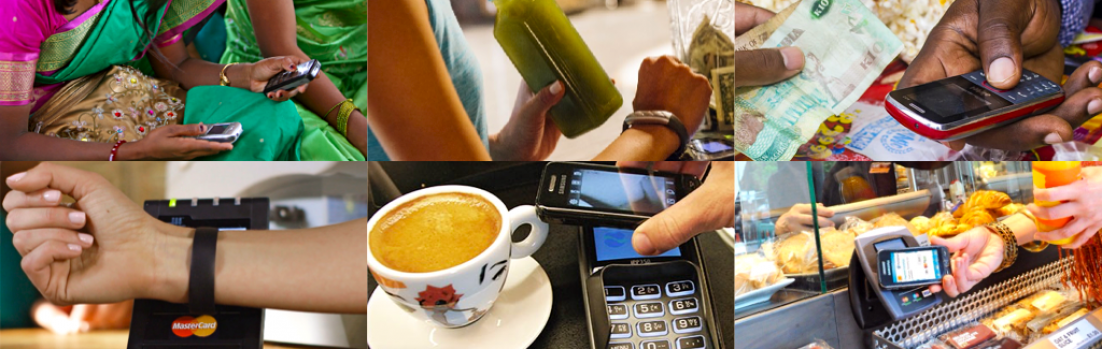

Michelle Evans, the digital consumer manager for Euromonitor International, shares some findings from the company’s latest global research.
Category Archives: Digital Transformation

Technological Advancements in the Financial Inclusion Sector
ADB – Financial Inclusion Newsletter – Financial Services for the Poor, Technological Advancements in the Financial Inclusion Sector, by Pradipto Pal, Accenture Digital. (I had written this article on my iPad, while having my breakfast at the Stormsriviermouth, Tsitsikamma, in South Africa – October 2014)
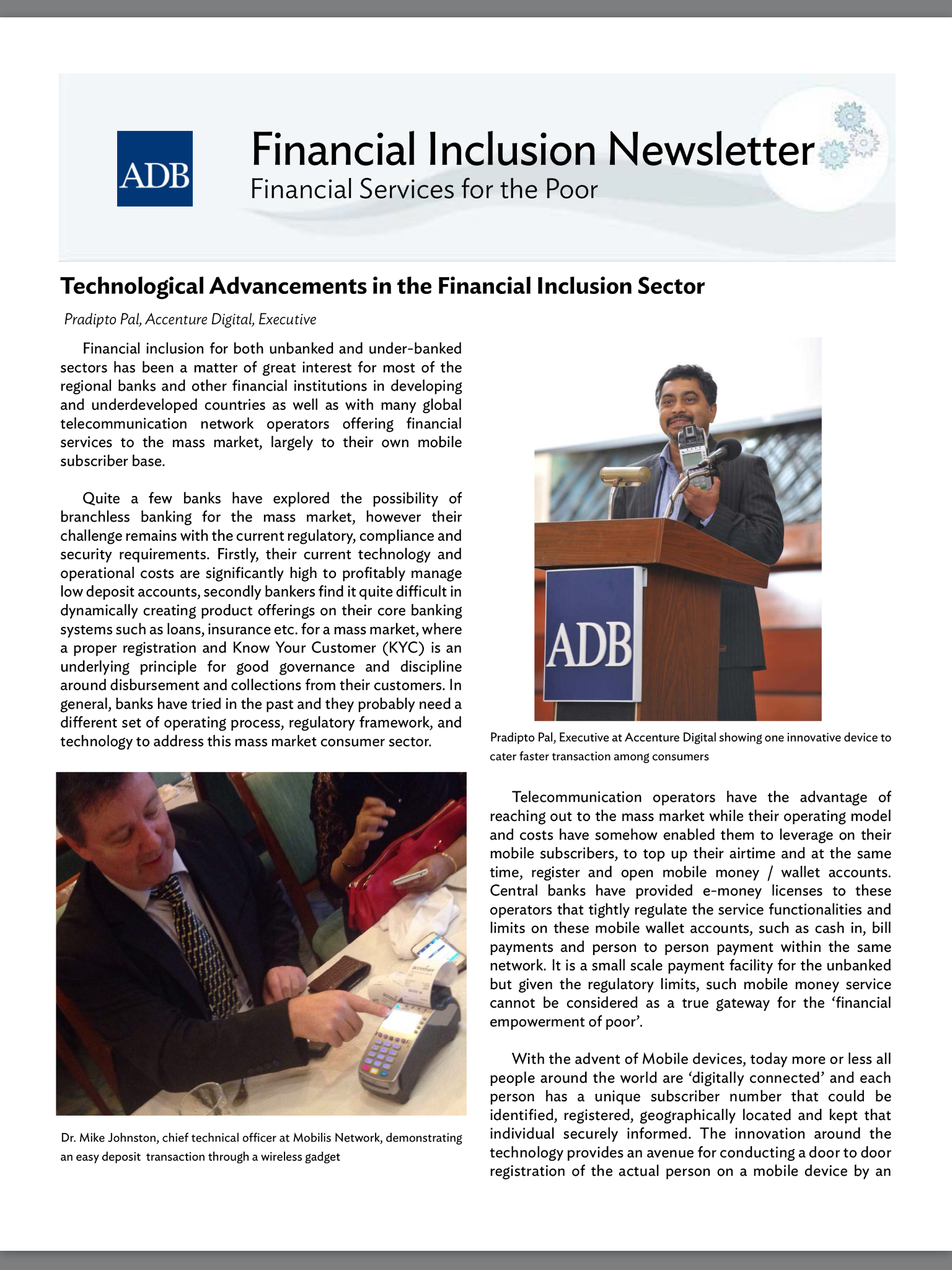 Financial inclusion for both unbanked and under-banked sectors has been a matter of great interest for most of the regional banks and other financial institutions in developing and underdeveloped countries as well as with many global telecommunication network operators offering financial services to the mass market, largely to their own mobile subscriber base. Quite a few banks have explored the possibility of branchless banking for the mass market, however their challenge remains with the current regulatory, compliance and security requirements. Firstly, their current technology and operational costs are significantly high to profitably manage low deposit accounts, secondly bankers find it quite difficult in dynamically creating product offerings on their core banking systems such as loans, insurance etc. for a mass market, where a proper registration and Know Your Customer (KYC) is an underlying principle for good governance and discipline around disbursement and collections from their customers. In general, banks have tried in the past and they probably need a different set of operating process, regulatory framework, and technology to address this mass market consumer sector.
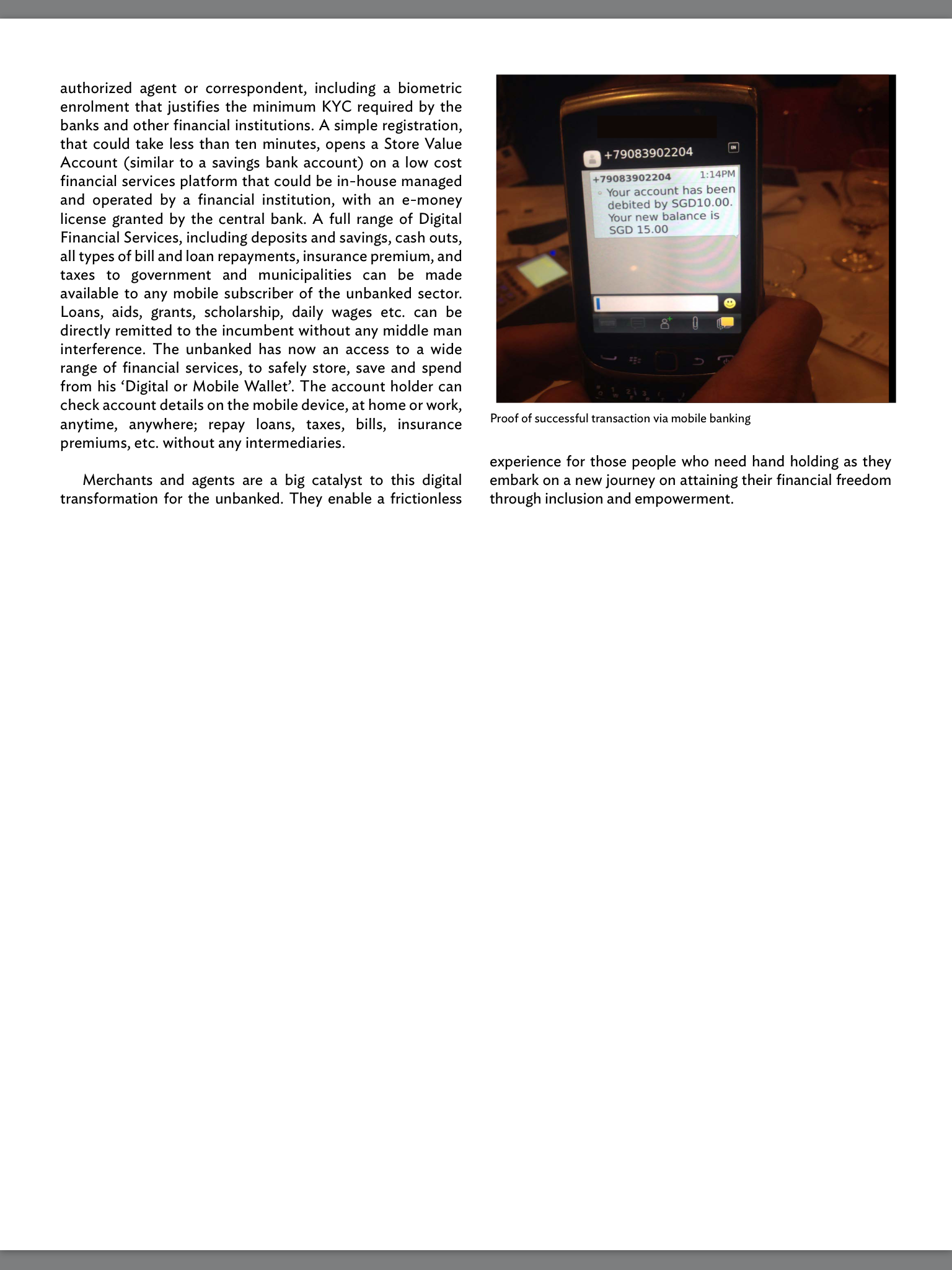 Telecommunication operators have the advantage of reaching out to the mass market while their operating model and costs have somehow enabled them to cater faster transaction among consumers to leverage on their mobile subscribers, to top up their airtime and at the same time, register and open mobile money / wallet accounts. Central banks have provided e-money licenses to these operators that tightly regulate the service functionalities and limits on these mobile wallet accounts, such as cash in, bill payments and person to person payment within the same network. It is a small scale payment facility for the unbanked but given the regulatory limits, such mobile money service cannot be considered as a true gateway for the ‘financial empowerment of poor’. With the advent of Mobile devices, today more or less all people around the world are ‘digitally connected’ and each person has a unique subscriber number that could be identified, registered, geographically located and kept that individual securely informed. The innovation around the technology provides an avenue for conducting a door to door registration of the actual person on a mobile device by an authorized agent or correspondent, including a biometric enrolment that justifies the minimum KYC required by the banks and other financial institutions. A simple registration, that could take less than ten minutes, opens a Store Value Account (similar to a savings bank account) on a low cost financial services platform that could be in-house managed and operated by a financial institution, with an e-money license granted by the central bank. A full range of Digital Financial Services, including deposits and savings, cash outs, all types of bill and loan repayments, insurance premium, and taxes to government and municipalities can be made available to any mobile subscriber of the unbanked sector. Loans, aids, grants, scholarship, daily wages etc. can be directly remitted to the incumbent without any middle man interference. The unbanked has now an access to a wide range of financial services, to safely store, save and spend from his ‘Digital or Mobile Wallet’. The account holder can check account details on the mobile device, at home or work, anytime, anywhere; repay loans, taxes, bills, insurance premiums, etc. without any intermediaries. Merchants and agents are a big catalyst to this digital transformation for the unbanked. They enable a frictionless experience for those people who need hand holding as they embark on a new journey on attaining their financial freedom through inclusion and empowerment. Financial Inclusion- Friction Less Ecosystem

As smartphone gets cheaper than a bicycle, its jingle bells for digital cash and mobile money
 It actually started to bite me in early 2007, when the thought of exploring the unknown… outside traditional technology and working for a while beyond the cubicles of corporate, came to my mind. Since last year, my friends have been nudging me to share my exotic experiences, as quite a few of them had made subtle indications, of-course post few rounds of beer, to retire for the better good of the investors. Often after midnight, I would say early mornings, I landed up paying for the endless beer and wine bottles. I have now become wiser, and it makes a good reason to share all those stories publicly, as my wallet feels safer and my friends can sit at their own cosy home, get their own beer cans and wine bottles and read Gooftagu on their tablets. I would talk another time about why I created Gooftagu..
During my school days, I went to spend my summer holidays, with my parents at a hill station in central India, where my dad was a medical doctor at the only general hospital in a district inhabited by three million people. He had three hundred beds and three other doctors supporting him to take care of the local inhabitants. Everyday morning, I saw the locals riding their bicycles coming down from their villages for selling their farm grown vegetables, eggs, milk, fish, including live chicken, rabbits, parrots, and lots of their own cottage stuff. They would mostly pay for their medical expenses with cash they got from selling their goods, and there were few who would try to exchange or barter their eggplants or other items for medicines and their treatments. Dad wasn’t happy about that, and he would take that personally and quietly pay on their behalf from my mom’s household expenses, and mom wasn’t happy either.
For these village folks, the most precious thing was their bicycle that they would not exchange for any reasons. Their lives would end in the absence of that human powered, pedal driven, single track vehicle. Before sunset, they would always cycle back to their villages with their cash and medicines. After so many years, probably their lives have changed, all of them now having mobile phones and are a part of the better world. Hopefully, their children and grandchildren have got education and now having secured meaningful earnings from their work areas. Given a choice today, between a bicycle or a smartphone, they would first pick a smartphone and probably claim both on a second chance. One thing, I am still unaware, whether they have any bank accounts today, since in those days it was only meant for the educated lot.
I opened my bank account at the official age of eighteen, and when I went to college. I queued up at the bank’s branch office during lunch hours to withdraw cash and have my bank’s pass book updated. Thirty-two years later, and it wasn’t until mid 2008, when I decided to dabble with two factor authentication. I was suspected as partially deaf on my left ear caused by a mobile phone that had a tendency to get hotter as it came closer to my left ear, as I was desperately trying to get an access to my bank’s call centre officer. I needed to know about my bank balance, and secondly if it has hit the pit-hole, as I was already hardened on this issue during my college days, courtesy my many areas of interest, beyond the usual academic and lab work.
While still clinging on to my mobile phone, it took me nearly 15- 20 minutes each time to get my account balance update, after enduring four-five sets of personal verification questions. Often the question could lead to ‘what is my last transaction’ or ‘my current balance’. The last one was the most frustrating, and I would generally hang up and read my star signs and find the next best day to call the bank. I would admit, that the call centre officer would coach me on how to set up a phone banking PIN, or Telephone PIN for a quicker service if I made a similar attempt next time. I would instantly forget it the next day, as I would not remember where I had actually stored that six digit code.
It took me three years to reach to a point, with more than half a dozen University guys in Singapore, having completed with their Masters and Doctorate, to bring them together in an independent start-up operation and build a bio-metric application using Voice for authentication. It wasn’t speech recognition, though we used some of the techniques in the overall process. Voice bio-metric authentication could be compared and could be as good, if not absolutely better when compared with thumb, face, or eye results. It is definitely unique and non-intrusive, can be used remotely relying on an inexpensive method, and all it needed was a phone that belonged to the identifier, and above all it is language and accent independent. I would write a separate note about all those great individuals who helped me through this journey to learn and discover, supported me either financially or spiritually in connecting the dots and helped us in more than many ways to explore the unknown. They are outstanding scholars and samaritans who stood by us for a good cause and reason. They remain as my life long friends and associate partners.
By late 2000, I was realising the insurgence of mobile phones in every house-hold and possible usage and application of Voice bio-metrics for people who were uneducated, underprivileged or deprived, and probably too poor to afford a telephone. It could happen in future, that such people could probably use their ‘voice’ to remotely access social services or provide authentication to receive their basic needs and any form of financial support. As their literacy level was not adequate, Voice biometrics could be an easier tool and inexpensive platform, that could assist NGOs to send their agents to deliver the goods and services to the ‘identified’ incumbent. As a second option, these people could jump on their bicycle to a nearby government authorised outlet for collection of goods and rations against a token number that they would have received via a SMS on Voice Authentication.
Welcome to the new age of digital barter system… now having coined this idea with my few friends.
We were sure about the extent of mobile phones penetration and I was personally wondering if someday, smartphones would be cheaper than a bicycle, it would potentially fuel the usage of mobile phones for conducting activities from home, other than making just voice calls. It would be a real Value Engineering.
If one could do a proximity purchase with a merchant of airtime card reseller at a local store, the same person could also buy or download some virtual cash, a digitised version, either by paying at the store, or in the same way the person would remotely buy a popular Bollywood song or video in either mp3 or mpeg format. If the Telco operator could do on a real time basis, airtime top up and charging, or deliver any other mp3/mpeg content, they could be in a position to allow subscribers to download, top up, transfer or exchange digital cash to and from the subscriber’s pre or post paid account,for a small flat fee.
It’s about three things; media, money and messaging that consumes the data pipe that a subscriber is willing to pay for downloading and sharing, in addition to the subscriber connection fee to the Telco operator. If the subscriber wants to inquire on the account balance, or make a payment to another person, all such ‘exchanges’ would occur on the operator’s network and it would be a simply be a matter of debit or credit between two subscriber accounts. Now, what could be better than the Voice bio-metric authentication to conduct such fund transfers and exchanges of digital content between the payer/subscriber and the payee/recipient – a next door grocery, village clinic or school, or paying their electricity bill, taxes or instead receiving some cash subsidy from government aid for medical and children’s education without cycling to the Centre and standing in the queue for mindless hours and filing up numerous forms.
What about the Telco’s? As one would expect, Telco’s would find new ways of making revenues, to provide what they call as value added services (VAS) to their subscribers. Probably, they would need a money licence from their country’s central bank, to collect and handle public funds, and they may be required to hedge that risk by reserving and keeping a certain amount of deposit with the local authorities against their money license. Telco could smartly partner with a bank, and safely store the consumer’s money with the bank, and that float amount would sit with the partner bank under the Telco operator’s account. The partner bank now has a broader reach and access through the Telco operator to the Telco’s subscribers, would be now acting as a partner to distribute and market bank’s financial products. Telco, the new Fintech of Digital Financial Services is now the sponsor and catalyst of the Financial Inclusion of the Unbanked.
The proposal could bring new dimension to Development Financing through micro-finance or micro-loan for improving subscribers’ quality of lives, and even helping them to buying a bike, a tractor or farming equipments with customised agro-loan. Telco owns and retains the most valuable information, the subscriber and customer data and knowledge. They would mine, and further harvest and disseminate the wisdom to the banks, other financial institutions and their own subscribers for improving their quality of life.
It would be really wonderful if the bicycle is not anymore the single point of failure, plus if the weather has been inclement and going out cycling is not one of the wisest thing to do when one has an ailing child or mother at home. I see data explosion, with lots of potential to capture that big data at an early stage for analysing and learning the nature of shifting demographics due to digital revolution. I will probably write on this, another day.
For now, I want to visit our early days and share on my next post, few videos on the Voice Biometric application on mobile devices that we built few years back…..and yes, there are customers in Asia who are proudly using our innovation.
Who will lead the mobile commerce charge?
 Who will lead the mobile commerce charge? Mobile_Commerce_Guide_2013
Engage Customers and Build Loyalty in Developed and Emerging Markets
The advance of mobile technologies, a surge of innovation in emerging markets and increased consumer requirements for enhanced retail experiences present opportunities for banks to expand into new service areas and extend their existing services to the unbanked. But banks are not the only ones taking note. Mobile operators, card issuers, app developers, and retail chains are also jockeying to establish competitive offers and grow their footprints.
With nearly 6 billion connections and counting, worldwide mobile penetration has already been remarkable. But mobility is not only enabling rich and always-on interactions. It is also transforming banking and commerce, creating a new mobile marketplace that is always accessible and always ready for business. The movement toward this new phase of mobility — which Accenture calls Mobile Life — is pushing mobile money offers in three distinct directions: traditional mobile banking services (mBanking Services), mobile payment services (mPayment Services), and mobile enabled consumer services (mEnabled Consumer Services). Often the initial point of entry for banks into the mobility arena, mBanking links customers’ bank accounts to their mobile devices and provides customers with a new way to manage their finances. Services can range from basic product information and Most banks are in the business of making money — and they have a huge learning curve to travel before they can serve the poorest of the poor. transaction histories, to more advanced operations such as loan applications and inter-bank fund transfers. Mobile money transfers and purchases, or mPayments, open the door to previously unbanked markets. These types of services can vary significantly in their sophistication, from SMS-based money transfers, to Near Field Communication (NFC) payments, to a full “digital wallet” capable of storing multiple credit cards, prepaid cards, and discount cards for mobile transactions and commerce. Least understood and not yet widely adopted, mEnabled Consumer Services encompass a broad range of mobility offerings catering to specific consumer lifestyle needs within and outside the traditional banking realm. Services can range from simple SMS-based promotion alerts to location-based targeted market-ing. With mEnabled Consumer Services, banks have the opportunity to venture into new businesses and further embed their brand in consumers’ daily lives. Banks may choose to extend existing offerings to new customers, branch out into new value segments or increase the sophistication of their services in a particular area. However, banks should be aware that they are not the only ones with this ambition. While the banking industry has dominated banking and payment services for many years, the recent advance of mobile technologies and emergence of new consumer behaviors has leveled the playing field. As a result, new entrants, new partnerships and new operating models are flooding the space and transforming the competitive landscape. Asia’s affluent Thus, many banks find themselves in an unfamiliar position, struggling to keep up — or join up — with mobile operators, card issuers, app developers, and retail chains that are also jockeying for position in a value chain that spans activities from banking to commerce to CRM.
Competition is stiff, particularly in Asia Pacific where a digital wave is creating a market hungry for mobile money services. Driven by the advance of a tech-savvy consumer base and a ‘change of the guard’ that sees Generation X making way for Generation Y to take the helm, this shift is happening much faster in Asia Pacific than in Europe or North America. Indeed, the youth segment in Asia Pacific is not only far greater in sheer numbers; it also has a much greater desire to lead a Mobile Life. This segment, which I describe as digital natives’, has a huge appetite for mobile/digital services. In fact, demand in the region far outstrips supply of both services and bandwidth. Notably, the rapid growth of the middle class across Asia Pacific presents players with additional opportunities. Another 70 million households are expected to join this burgeoning class by 2015, and this impressive income growth extends all the way up the social ladder. Between 2010 and 2015, the number of millionaires in the Asia Pacific region is forecast to increase by 25 percent (compared to 17 percent world-wide), while the ’ultra wealthy’ segment will swell by 37 percent (nearly double the global rate). The region is not only growing richer; it is also becoming more passionate about mobile technologies and services. The outcome will be an increase in smart-phone penetration, a trend we already observe, that will drive more mobile app downloads and usage of the mobile Internet. Significantly, NFC will likely gain serious traction, with an estimated 450 million NFC-capable devices expected to hit the market over the next three years. As more people embrace a Mobile Life, the demand for services — including banking, payments and commerce — will skyrocket. In fact, Accenture research found that 60 percent of mass affluent customers, which includes the region’s upper middle class and high-net-worth individuals, are interested in using digital channels in conjunction with bank branch visits. In addition, 21 percent of respondents would prefer to switch completely to direct banking. Four mobility value segments for banks Mobile as a platform to improve bank’s operational efficiency Enterprise focus Customer focus Mobility transformed banking processes m-salesforce m-Salary m-Allowances m-Claims mEnabled enterprise mBanking services mPayment services Mobile as a new interactive channel to increase customer loyalty and cross-sell opportunites mEnabled consumer services Mobile as a conduit to build brand presence and integration into consumer’s daily lives Mobile as a payment tool to target unbanked sections of society and expand mCommerce opportunities Mobile wallet (Stored value account) mCommerce Augmented reality, for e.g. real-time property guide Mobile Life White space represents the untapped opportunities as a result of new business and/or operating models
Now that I have described the key market demographics and data points across the Asia Pacific region, let’s examine how mobile banking services have evolved across the region. Dramatic economic growth and rising household incomes across the region have created a market of mass affluent. This segment carries a mobile phone and is already well accustomed to using mobile banking services to check balances, pay bills and make P2P transactions. The next step is full mobile commerce, a space where banks and merchants have an important role to play. Together they must build on the mobile wallet, a product banks first provided to make P2P payments, and extend that functionality to enable and enhance new retail experiences. Let’s say I use my mobile wallet, provided by my bank, to do some shopping and buy some clothes at Store X, for which I also receive some loyalty points as part of the transaction. A few days later I walk into a shopping mall in a different city, where the same chain just happens to have an outlet. I don’t know this, but I do receive a push notification directly to my mobile phone that says “Hi Pradip, if you are nearby and walk into our store, we will give you a 10 percent discount on your next pair of jeans and you can use your loyalty points”. Now let’s look at this from the perspective of the store merchant. First, this is a new retail experience that only mobile can deliver. It can’t be done with any other channel because there is no other channel I have on my person at all times, even during shopping and — more importantly — no other channel can deliver location-based services coupled with deep customer insight. The beauty of this is that this channel allows the consumer to pay from a mobile wallet and not a credit card, which means the merchant does not have to pay the 2-3 percent charge to the credit card company. For the merchant it’s a win-win all around. They get their money up front and without having to pay the fee to the credit card company. What’s more, the merchant now has a deeper relationship with the consumer, one that allows them to grant loyalty points and thereby encourage a return visit or purchase. From the perspective of the bank the mobile wallet currently sits outside the core banking system. In practice I can transfer money from my account to a mobile wallet. However, clever banks are also taking advantage of the opportunity to provide me additional wallets for family members, for example. In this scenario I have the option to open up a family wallet, or perhaps separate wallets for my wife and daughter. I am still the account holder, but the bank has now gained two ‘new’ customers — my wife and daughter — and sees a two-fold increase in transactions and revenues. The additional mobile wallets allow us all to conduct commerce without cash or cards, so we are happy. The merchant also benefits for the reasons I mentioned. The result is a virtuous cycle benefitting the bank, the merchant and the ‘less cash’ consumer. But banks are not alone. 26 Mobile Commerce Guide Engage Customers and Build Loyalty in Developed and Emerging Markets 27
Adults who do not use formal financial services
Percent of total adult population that is financially unserved 136 A day in the life of a ‘less-cash’ consumer society of the future 6.30am > Top up transport card/ mobile 7.30am > 9.00am > 10.30am > 12.30pm 3.30pm > 7.00pm > 9.00pm > Pay for train ticket Gain access to office Transfer money to sister The cycle continues Incoming transaction Outgoing transaction Transfer Security transaction 28 Mobile Commerce Guide Engage Customers and Build Loyalty in Developed and Emerging Markets 29 They are confronted by new entrants and competition from companies across the merging mobility value chain. Banks must adjust to this reality, which is why Accenture has recently surveyed the Asia Pacific land-scape and developed the Accenture APAC Banking Mobility Maturity Index. While it is beyond the scope of this article to discuss the Index and the factors, such as banking access and mobile subscriptions, that have important implications on a bank’s mobile commerce and wider mobility strategy, it is important to stress that banks have a limited time to master the capabilities to deliver a full mobile commerce experience, one that allows people — especially those ‘born digital’ — to do much more with the mobile phone they already reach for on every step of the consumer journey. Nearly all of the world’s financially unserved adults live in Africa, Asia and Latin America Millions of adults East Asia South Asia Sub-Saharan Africa Latin America Central Asia and Eastern Europe Arab States.
In the view of Accenture, as the balance shifts from cash to contactless payment, banks operating in Asia Pacific have a unique but fleeting opportunity to extend their reach across the entire socio-economic spectrum and position themselves at the heart of these ‘less cash’ consumer societies and retail value chains of the future. Which value segments and audiences each bank pursues will depend on the opportunities available in their markets and their own ability to compete. Unbanked opportunities While economic growth across Asia Pacific has been dramatic, the GSMA reports1 that 2.5 billion adults, just over half of world’s adult population, are unbanked, meaning they do not use formal financial services to save or borrow. These unbanked populations have quite basic needs, which first-mover banks such as Dutch-Bangla Bank in Bangladesh are meeting with mobile banking services that include airtime top-up, cash-in, cash-out, utility payment and remittance — to name a few. In markets such as China, Indonesia, Malaysia and the Philippines, where there is a large population of migrant workers, the unbanked have a particularly strong demand for mobile banking services that allows mobile money transfers within and across national borders. Interestingly, this is also a space where mobile operators, such as Ooredoo, have a huge opportunity because their footprint allows them to facilitate remittances on a large scale. However, that is the catch. Mobile operators that want to target the unbanked will not want to do it as single operators. They will want to do it as part of a kind of ecosystem so they can benefit from sharing infrastructure and best practices. New mindset Significantly, banks have the capabilities mix — and the corporate DNA, to extend their services to the world’s unbanked. However, not all have the proper mindset for the task. The unbanked are not unbanked because they don’t work or earn money. In many cases, the unbanked lack a residential address, or fail to earn a salary that covers the fee structure offered by most banks, and discourages small deposits. However, mobile allows economy of scale, increasing reach and lowering costs and allowing banks to generate revenues by serving a large volume of low income customers. Here the expectation is that the mobile wallet will evolve to drive financial inclusion by creating a mobile marketplace where the unbanked can buy goods and services, as well as access financial products, such as insurance, that will allow them to plan a secure and stable future. Financial inclusion will also make it much easier for governments and NGOs (non-governmental organizations) in developing markets to disperse aid and so push money to the mobile wallets of the poor. There is also a knock-on benefit for NGOs — and banks that choose to grasp the opportunity — to provide microfinance. Loans and credit extended to the poor will not only help improve their lives; the wealth created will increase overall GDP and inject new dynamism into local economies. Clearly, the role of mobile in these markets is to facilitate payments. However, it has the powerful potential to transform entire econ-omies. In some regions, such as Bangladesh, it is possible to glimpse that future today. However, this progress also raises a question mark over the future role of banks in enabling commerce in unbanked markets. While many banks are no doubt defining the course of mobile commerce, acting as the ambassadors of mobile commerce, it is a herculean task that not every bank can master. Besides, many banks are not able — or willing — to offer additional services to encourage commerce at the bottom of the pyramid. They prefer to focus on serving Banks have a limited time to master the capabilities to deliver a full mobile commerce experience, one that allows people — especially those ‘born digital’ — to do much more with the mobile phone.
Certainly, the banks, with the exception of those institutions dedicated to driving financial inclusion, will likely not be among the legends in the business. Put simply, most banks are in the business of making money — and they have a huge learning curve to travel before they can serve the poorest of the poor. New entrants, challenges Driving mobile commerce requires the grit and the power to roll services out to a customer base of 100 million customers and more. It also demands that the company undertaking this is not measured by the same KPIs applied to financial institutions. Therefore, it is quite probable that large organizations — such as mobile operators, governments, NGOs or even large petro-leum companies — will have the resolve to accept this challenge and drive the transformation of commerce. And we should not rule out the potential of new entrants to stake their turf in the global mobile commerce space. Banks may have dominated with banking and payment services, but many will soon find themselves struggling to keep up. Mobile operators are joining together, and some are teaming up with card issuers, such as Visa and MasterCard to offer NFC and mobile wallet services. At the other end of the spectrum e-money providers such as PayPal and Singapore-based NTS and Korea Smart Card Company, which provides T Money, are capitalizing on their strong presence in certain local markets. Finally, transport companies are also taking advantage of easy access to customers at the point of sale to offer mobile payment services. Hong Kong’s Octopus card, launched by a local transit company joint venture to facilitate fare payment on the city’s mass transit system, is a good example. The Octopus card has since spread its tentacles to capitalize on growing demand for contact-less payments in other areas of consumer life. Today, this rechargeable stored-value card can be used to pay for parking and fares on all modes of transport, and is accepted by many retailers, including fast food restaurants and supermarkets. And there other scenarios, enabled by new technologies, that are poised to move commerce to the realm of machines. If we consider the interactions that lead those ‘born digital’ to an actual purchase, we begin to see a path that takes them from one ‘machine’ to another. A typical scenario could look something like this: The digital native watches Smart TV, using the app from the relevant app store to purchase the item they see on TV using their mobile phone. For that transaction there doesn’t really have to be a full-fledged digital wallet; there only needs to be technology in the background that can ‘see’ the machine-to- machine operation between the TV and the mobile phone and relate this to the customer and CRM. Although cash is unlikely to be eradicated completely in the foreseeable future, the gradual movement toward electronic currencies and virtual transactions is edging us ever closer to a ‘less-cash’ society for both consumers and industry. All indicators suggest Asia Pacific may be first to fully embrace Mobile Life. Now it is up to companies across this emerging ecosystem to adapt to the fast-paced nature of mobile technology and secure their position in this increasingly competitive mobility landscape.
 GOOFTAGU